My Ichiban Lager clone is still cold-aging in the fridge, will probably bottle it at the end of the month. My extract blueberry wheat, which I made for Mrs. Brew Dude, is close to ready for bottling after a very vigorous fermentation. A stray blueberry actually got stuck in the airlock and the fermentation gases actually cause a few berries to burp out of the top of the bucket, causing a small mess. I think we're still ok, sanitation-wise, as tastes out of the fermentor have been promising.
Next batch will be an all-grain American Wheat, just in time for the dog days of summer. After that, I'll be planning my next few brews. Looking at another Pumpkin Ale, maybe a Brown, a stout, and wondering if I have the patience for a Barelywine. Strong beers like Barleywine need lots of time to mellow in the bottle, just like grape wine, and many recipes recommend 6 months to a year in the bottle before cracking them open. I'm having enough trouble waiting for my 6-week lagering process...
Lots of summer beers have been rolling out around town, my favorites so far have been Magic Hat's Whacko Summer Ale (wheaty and crisp), and South Hampton's Double White. It's a very sweet, higher alcohol, Begian-style wheat beer. I found both on tap at Rocket Bar in Chinatown.
Stay cool out there!
Showing posts with label DC. Show all posts
Showing posts with label DC. Show all posts
Monday, July 13, 2009

Thursday, June 18, 2009
All Grain Brewing Made Easy
Traditonal homebrewers who make the switch to all grain brewing (no extract syrup) have fairly complex setups with at least two, but more likely three vessels: a hot water tun (holder), a mash tun, and the brew kettle.
Being that I live in a 600 sq. ft. condo, this isn't really feasible for me. So I did some research and found out about an innovative technique originated in Australia called Brew in a Bag.
In essence, instead of mashing and sparging (rinsing) the grains in a separate vessel, I used a $2 nylon mesh paint straining bag to mash the grains in the full boil volume of water in my brew kettle. Join me on my adventure...
Brew day starts like any other: sanitizing, getting ingredients ready, weighing out hops, etc.
On this brew day, I was trying a Kirin Ichiban clone, using 4 lbs of American 6-row barley and 1 lb of flaked rice adjunct, 1 oz Hallertauer Hops, and dry lager yeast (to save a bit o' green).
 Since we are using flaked rice, this will require a multi-step mash to adequately break down the fermentable sugars in our grains. The first step is to heat up the strike water that the grain will be added to. I want my final volume into the fermentor to be 2.5 gallons, so I have 3.5 gallons in the brew kettle to start to compensate for the grains soaking up water and whatever will steam off during the boil.
 As you can see, the paint strainer bag fits nicely over my 5 gallon brew kettle. Once the water is sufficiently heated, we dump in the grain and stir, stir, stir.
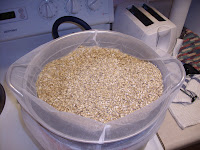 My lager recipe call for rests at 122°, 140°, 158° and mash-out at 170°F. Traditional brewers accomplish these rests by starting with less water and adding more hot water as they go along. But I just used my stove top and the last few minutes of one rest to ramp up to the next one. Seemed to work ok.
 Once the mash is complete and most of the fermentable sugars have been steeped out of the grains, we simply lift the strainer bag out of the brew kettle and the sweet wort is left behind. I put the moist grains in a colander resting on top of my brew kettle and let it drip for a few more minutes.
 After that, brewing proceeds as normal, with three hop additions splitting up the hour-long boil.
 After the boil, I chilled the wort off in the sink. I may need to buy a bag of ice for my next brew, since there is a lot of thermal mass in there and just sitting in cool sink water led to about a 45 mintue wait until it had reached yeast pitching temperature.
 Since this is a lager, I let it begin fermentation for one day at room temp, and then stuck it in the fridge. Hopefully this will produce a clean, crisp summer beer.
.
I have tried the BIAB technique once before, with an American Pale Ale. I cracked open the first one of those this week:
 As you can see, it's a bit hazy with a decent white head. It is less hoppy than most examples, with a smell I can only describe as beery (in the most positive sense one can take that). It has a sweet, bready and fruity taste, and finishes with an ever-so-slightly hoppy and crisp aftertaste.
I love this beer. I predict that it will not last long.
.
So if anyone out there wants to get into all grain brewing but doesn't think they have the chops or space, give Brew in a Bag a try. The freshness you get from using grains instead of extract is worth the additional equipment investment and grains are much cheaper than syrup anyway, so you'll save money in the long run!
.
.
Happy brewing and drinking!
Monday, April 6, 2009
Weizenbock

 My weizenbock (dark wheat) was ready to drink this weekend.
As you can see, it's a deep, dark red. Taste-wise, this is the hoppiest beer I've made so far, but they aren't aggressive and blend nicely into the caramel sweetness in the finish. A very nice beer to sip while chatting with friends or watching tv.
The problem with the Mr. Beer ingredients I seem to be having is that, while the beer tastes good, I wish there was more to it. I think it has to do with how the ingredients are portioned. Mr. Beer recommends two cans of extract per half-gallon batch, which equates to roughly 2 lbs 6 oz of extract per 2.5 gallon batch. Most recipes call for at least 3 lbs of fermentables per 2.5 gallons.
My last batch of Mr. Beer-ingredient beer (a hazelnut coffee brown) is in the fermentor now. After that, I think I may be done with Mr. Beer ingredients for the time being and have already ordered stuff for my first partial mash: A Steam-style beer!
Stay tuned for a full partial mash rundown!
Wednesday, March 18, 2009
The Setup...
Due to popular demand, I'm going to show you good people our homebrew setup.
The one that started it all...
The one that started it all...

My Weizenbock is fermenting happily on our kitchen shelf next to some salvaged, pry-off bottles that it will go into this weekend. The two-handled thing is the bottle capper.
And the fermentor that we made ourselves.

A good fermentor only has two requirements: it can hold liquid, and have some method of allowing gases to escape, while not letting any bad nasties in. We used a rubber stopper and airlock setup. The liquid in the airlock is vodka. You want something that won't harbor bacteria.
In order to avoid buying (and having to store) any siphon equipment, I recommend installing a bottling spigot on the fermentor as well. If the bottom of the spigot inlet is about 1/2 inch from the bottom of the bucket, you should be safe from getting any trub (gunk from the bottom) in your bottles. Also, avoid the spring-loaded spigots, as the spring will lose tension over time and you will lose your airtight seal.
I got the bucket and lid from usplastics.com and the stopper, airlock, and spigot from stompthemgrapes.com. All together with shipping, it was about $20. Also, you will need a 1 inch spade drill bit and an electric drill to make the holes in your bucket.
The Day After.
St. Patty's was yesterday, hope you had a good one.
The wife and I went out to a happy hour, nothing too crazy. Apparently, some people take off all day March 17 and 18 as a matter of principle. Now, I like to drink, but I don't know if I could manage it from breakfast to bar close. These people have a real problem and are also great American heroes.
Also, new beer discovery: Allagash Black.

I'm a big fan of the Allagash White, though it's usually at least $6 a glass wherever you go and $10 a four-pack if you want to take it home. The Black was $7 for a quarter liter at The Big Hunt in Dupont, but the slightly higher gravity almost makes up for it.
Taste-wise, it's very sweet and thick as a brick. Very roasty without the burnt taste that can sometimes crop up in very dark beers. Almost no hop character at all. If you know someone who doesn't like beer, blindfold them and have them try this.
Speaking of people who say they don't like beer: With all the varieties available, I think it just comes from a fundamental lack of effort. It's the third-most popular drink in the world, with 80 recognized styles, and untold variations between. Surely there's something in there you can stomach.
Saying you don't like beer is like saying you don't like bread. Or vegetables. I have problems with those people, too.
The wife and I went out to a happy hour, nothing too crazy. Apparently, some people take off all day March 17 and 18 as a matter of principle. Now, I like to drink, but I don't know if I could manage it from breakfast to bar close. These people have a real problem and are also great American heroes.
Also, new beer discovery: Allagash Black.
I'm a big fan of the Allagash White, though it's usually at least $6 a glass wherever you go and $10 a four-pack if you want to take it home. The Black was $7 for a quarter liter at The Big Hunt in Dupont, but the slightly higher gravity almost makes up for it.
Taste-wise, it's very sweet and thick as a brick. Very roasty without the burnt taste that can sometimes crop up in very dark beers. Almost no hop character at all. If you know someone who doesn't like beer, blindfold them and have them try this.
Speaking of people who say they don't like beer: With all the varieties available, I think it just comes from a fundamental lack of effort. It's the third-most popular drink in the world, with 80 recognized styles, and untold variations between. Surely there's something in there you can stomach.
Saying you don't like beer is like saying you don't like bread. Or vegetables. I have problems with those people, too.
Subscribe to:
Posts (Atom)

